The Nation, 28 September 2009

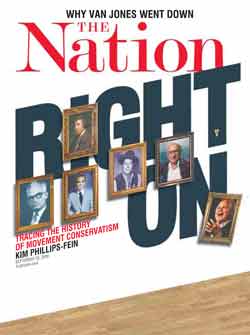
nation 28 september 2009In this issue, Kim Phillips-Fein looks at a topic we spend a significant amount of time on here at Los Thunderlads, the political label “conservative” and the odd collections of people and ideas that have been grouped under it over the years.  Phillips-Fein faces an impossible task; her 3-page piece is packaged as a review essay on 12 books, and as she goes she is constrained to mention several more books and articles.  What she has written would be a fine introduction to a bibliography on recent scholarship about the American Right.  There is one snippet in the piece I’d like to quote.  Describing the attempt by New York Times writers David Brooks and Sam Tanenhaus to enshrine a traditionalist conservatism of the sort that writers like Irving Babbitt, Russell Kirk, and George Nash found in the writings of Edmund Burke, Phillips-Fein expresses skepticism that such a conservatism is likely to flourish in America.  “That Brooks and Tanenhaus find the motif of Burke appealing is largely a sign of their longing to revive a serious, sophisticated and mature conservatism, and their sense that, thanks to the radicals, the right is in desperate straits and has entered a period of decline.” 

I don’t know whether Tanenhaus and Brooks believe that the American Right is in decline as a political force.  I for my part find it hard to escape the conclusion that it is in a very bad way as an intellectual tradition.  Readers of this blog will have noticed that I spend a lot of time reading magazines like The American Conservative and Chronicles; so it shouldn’t be surprising that I sympathize with their desire to provide America with a conservatism worth arguing against. 

A column about Harvard Medical School’s vague conflict-of-interest policy mentions the fact that some researchers at that institutions have received over $1 million dollars from companies they are supposed to be observing disinterestedly.  Its dean “wants to increase, not decrease, the  school’s connections with industry.”
(more…)

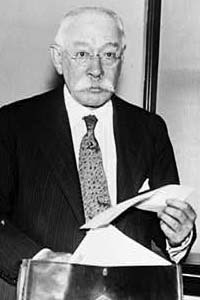
The Wickersham Report on Lawlessness in Law Enforcement

George Wickersham, 1930

George Wickersham, 1930

I’ve been meaning to post a “Periodicals Note” about the July issue of Counterpunch, in which “Peter Lee” wrote about the report that a commission headed by one George Wickersham submitted to US President Herbert Hoover on 7 January 1931.  The Wickersham Commission had investigated charges that US law enforcement agencies were using torture to enforce the prohibition of alcohol that was then in effect across the United States.  The commission’s staff was led by a civil liberties lawyer named Zechariah Chafee, and Chafee turned up evidence that made the Wickersham report impossible to ignore.  Lee gives considerable detail from the report, and points out that all of the “enhanced interrogation” techniques that CIA and military interrogators have been accused of using against captives in the “war on terror” were familiar to Prohibition agents in the 1920s.  Those methods disgusted the American public then, and the exposure of them did a good deal to spur the movement that ended Prohibition.  The difference in the outraged public reaction of 1930 and the muted public reaction to the exposure of the same methods in the last five years cannot be attributed to the difference between accused bootleggers and accused terrorists; Lee points out that torture is not in fact a very effective way of thwarting terrorists.  What has changed is us.  The headline above Lee’s piece is “When America Said No!”  His implication is that the American people have lost the moral compass that once enabled them to say no to torture.   

(more…)

The American Conservative, October 2009

american conservative october 2009

The cover may suggest an alarmist piece about Pakistan.  The article actually in the issue, though, is precisely the opposite.  Granting that Pakistan is an important country that has very serious problems, it asserts that there is no chance that it will break up, fall into the hands of Osama bin Laden, or launch a nuclear attack.  If the USA sobers up and pursues a more realistic policy in Afghanistan, Pakistan might even make progress on its real problems.

Elsewhere in the issue, Andrew Bacevich quotes Cold Warrior Richard Pipes’ 1979 declaration to the effect that since Afghanistan is a place of no strategic importance, the Soviet invasion of that country must have been a step towards a goal elsewhere.  Bacevich agrees that Afghanistan was without strategic importance when Pipes said that, and says that it continues to be so.  Where he disagrees with Pipes is in his assessment of the rationality of the Soviet leadership of the 1979-1989 period, and indeed of the US leadership of today.  He claims that the Soviets invaded Afghanistan because they believed that showing power there would shore up their empire; in fact, the Soviet occupation of Afghanistan was a significant factor in the eventual collapse of the USSR.  Likewise, America’s leaders want to persist in Afghanistan, not because of they have made any rational calculation indicating that they should, but because they are dare not make a calculation that might indicate that they should not.

This issue includes a piece by always-intriguing, highly eccentric writer Eve Tushnet.  Tushnet has a gift for the lapidary; she describes growing up in Washington, DC as one of very few white children in her neighborhood, albeit one “weird enough that my skin color was not one of the obvious targets of teasing.”  Recounting her childhood Halloweens, she writes that “A mask is above all an attempt to communicate, to create and reshape meaning over the silence of skin.”  Quite a provocative phrase, “the silence of skin.”  On a par with her line from 2008, “by religion, I mean an understanding of the nature of love.”

(more…)

The Nation, August and September 2009

It’s been a busy few weeks in the Acilius household, and the blog has suffered.  Here are quick notes on four recent issues of The Nation.

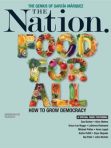
nation 21 september 2009

21 September: A special issue on food brings a bit of New Left- Old Right convergence as Michael Pollan writes in praise of Wendell Berry. 

Alice Waters writes about the idea of “Edible Education,” and describes what happens in schools where the cafeteria not only serves wholesome food, but involves students in the processes of preparing and cleaning up after the meal.  Waters quotes Thomas Jefferson on the virtues of the yeomanry, and concludes with a claim that “Edible Education” can help to build an ocietyethic of stewardship and with it a caring society. 

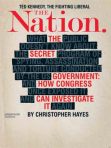
nation 14 september 2009

14 September: A call for an investigation of the CIA’s conduct in recent years addresses claims that such an investigation would demoralize the agency’s staff.  The article quotes former NSC official Richard Clarke:

Richard Clarke has little patience for it. “What bothers me,” he says, “is the CIA’s tendency whenever they’re criticized to say, If you do your job, if you do oversight seriously–which Congress almost never does–then we’ll pout. Some of us, many, will not just pout; we’ll retire early. Our morale will be hurt.” And if morale is hurt and the agencies are gutted, they argue, the country will be exposed to attack. In other words: “If you, Congress, do oversight, then we’ll all die. Can you imagine FEMA or the agricultural department saying we’re all going to retire if you conduct oversight?” Clarke asks in disbelief.

A harshly negative review of a retrospective of the works of artist Dan Graham mentions a work the reviewer considers superior to Graham’s,  Mel Bochner and Robert Smithson’s Domain of the Great Bear, which appeared as an article in Art Voices magazine in Fall of 1966, and thus “inaugurated this genre” of magazine piece as conceptual art, the genre in which Graham would earn fame.   

A review of a new selection of Wallace Stevens’ poetry mentions many poems,but leaves out that we might have expected to see discussed in a magazine with its issue date, “The Dwarf”:

Now it is September and the web is woven.

The web is woven and you have to wear it.

The winter is made and you have to bear it.

The winter web, the winter woven, wind and wind.

For all the thoughts of summer that go with it,

In the mind, pupa of straw, moppet of rags.

It is the mind that is woven, the mind that was jerked

And tufted in straggling thunder and shattered sun. 

It is all that you are, the final dwarf of you,

That is woven and woven and waiting to be worn,

Neither as mask nor as garment but as a being,

Torn from insipid summer, for the mirror of cold,

Sitting beside your lamp, there citron to nibble

And coffee dribble… frost is in the stubble.


nation 31 august 200931 August: Benjamin Barber points out that public space

is not merely the passive residue of a decision to ban cars or a tacit invitation to the public to step into the street. It must be actively created and self-consciously sustained against the grain of an architecture built as much for machines as people, more for commercial than common use.

He argues that public art is an essential part of public space.  Getting rid of cars is the easy part; filling a space with art, and with people who are alive to that art and to each other, is harder.

The Economist, 5 September 2009

economist 5 september 2009I can’t resist quoting some lines of verse that appear in this week’s obituary for Stanley Robertson, a Scotsman who made his living filleting fish in a cheap eatery in Aberdeen and who made his name as a storyteller, a bard who had learned a vast number of traditional tales and songs of the Scottish Travellers and who held audiences spellbound on both sides of the Atlantic.   Here’s a playground rhyme Robertson liked:

Eenie meenie mackaracka,

Rair roe dominacka,

Soominacka noominacka,

Rum tum scum scoosh!

A short article describes “Quest to Learn,” a new school in New York City that does away with the division of the day into class periods themed around particular subjects and replaces it with “domains” in which students work collaboratively using various methods that have been studied by educational psychologists and developed by video gamers.  The video game theme is incorporated so deeply that tests aren’t called tests, but “Boss Levels.” 

Also in this issue, a review of Richard Dawkins‘  The Greatest Show on Earth: The Evidence for Evolution, takes a rather mystified tone in discussing the existence of so many people in the USA who disbelieve in evolution.  Facing the idea of “Intelligent Design,” the reviewer asks why an intelligent designer would not have created an ecosystem in which all life-forms lived out full life-spans with a minimum of fuss and bother.  “All trees would benefit from sticking to a pact to stay small, but natural selection drives them ever upward in search of the light that their competitors also seek. Surely an intelligent designer would have put the rainforest canopy somewhat lower, and saved on tree trunks?” 

(more…)

The American Conservative, September 2009

american conservative september 2009One of the traits of this magazine is a tendency to grandiose theoretical explanations.  That’s one of the things I like about it; I’m into grandiose theoretial explanations myself.  It isn’t scholarly publication, and few of its authors have academic reputations to defend, so that tendency is not always restrained by the standards that keep theorizing under control in academic journals.  Sometimes that means that the magazine runs a provocative, bold idea that might not have survived heavier editing; sometimes it means that it runs something that’s just plain cheesy quality.  Again, I’m a pretty cheesy guy, so that’s okay with me. 

For example, this month Ted Galen Carpenter points out that Americans by and large are quick to view political disputes in foreign countries in a romantic light, seeing the ghost of Thomas Jefferson in all sorts of unlikely figures.  The next piece, by John Laughland, picks up on this same theme, explaining this American tendency as a sign of the influence of the philosophy of the Enlightenment.  Laughland writes that “the key to understanding the West’s love of revolutions” is Westerners’ characteristic desire to believe that “politics can and should be a story with a happy ending.”  This desire has run rampant in the West ever since the thinkers of the Enlightenment undermined the traditional Christian belief that the cosmos was ordered in a hierarchy, that justice was to be found in that hierarchy, and that the ruler’s power should be limited because the ruler was subordinate to God.  Laughland identifies Immanuel Kant as “the greatest of all Enlightenment philosophers,” and summarizes Kant’s theory as a belief that ordinary reality is unknowable, but that the highest reality is “the categorical imperative- an abstract universally valid proposition that becomes real when it is willed.”  Proceeding from these rather drastic simplifications, Laughland declares that:

The attraction of Enlightenment liberalism, therefore, is the result of a deep emotional need for a philosophical sytem that enables man to create a reality in a universe he does not understand and thereby to escape from the difficulties of the world by believing that everything will turn out all right in the end.  Lacking a real belief in the afterlife, it also holds that the drama of human salvation is played out in this world, in history and politics. 

Again, this is a severe oversimplification, but it has a certain plausibility.  Where Laughland really goes off the rails is in his closing section, in which he argues that Enlightenment liberalism has an “objective ally” in Islam:

[B]ecause it has no priesthood, Islam, and especially Shi’ism, is fundamentally a “democratic” religion comparable to Puritanism and other forms of Presbyterianism.  There is no established hierarchy; the Koran must be read equally by all.  Of course Allah is supreme and Islam demands absolute submission to Him; on the face of it, this seems the opposite of the liberal model in which the individual is subjected only to himself.  But this very submission is egalitarian, creating a mass of individuals who are equal in their abstractness.  Moreover, God’s will is [merely] will, it has no correlation with natural law as in the Christian or Jewish traditions.  Islam is therefore a profoundly voluntarist religion.  Because Allah is absolutely transcendent and unknowable, he is like the Kantian thing-in-itself: mere command. 

(more…)

The Funny Times, August 2009

Layout 1Ray Lesser’s “Your Inner Fish” includes these two memorable paragraphs:

In his book Your Inner Fish, [Professor Neil] Shubin describes many of the recent amazing discoveries in paleontology and genetic research to explain human origins and evolution. We quite literally contain the entire tree of life inside our bodies. He says humans are the fish equivalent of a Volkswagen Beetle souped up to race 150 mph. “Take the body plan of a fish, dress it up to be a mammal, then tweak and twist that mammal until it walks on two legs, talks, thinks, and has superfine control of its fingers — and you have a recipe for problems.”

The difficulty of engineering a fish to walk on two legs has resulted in many a sore knee and sprained ankle, not to mention closets full of poorly fitting shoes. The strange loops and detours our nerves and veins have to take to get around various organs lead to other common annoyances such as hiccups and hernias. Four of the leading causes of death in humans — heart disease, diabetes, obesity, and stroke — are mostly due to having at our core a body that was designed to swim around all day, rather than sit on its keister surfing the Internet, or drive truckloads of sardines from L.A. to Indianapolis. Fish don?t get hemorrhoids, either.

Jon Winokur’s “Curmudgeon” column collects quotes on boredom.  My favorite is from Henry Kissinger, “The nice thing about being a celebrity is that when you bore people, they think it’s their fault.”  Norman Mailer and Bertrand Russell are not as far apart as one might suppose; Russell said, “Boredom is a vital problem for the moralist, since at least half the sins of mankind are caused by it.”  Mailer said, “”The war between being and nothingness is the underlying illness of the twentieth century.  Boredom slays more of existence than war.”  These two are not far from an author Winokur leaves out, Blaise Pascal, who famously attributed most of the trouble in the world to people’s inability to sit quietly in their rooms.  Frank Moore Colby said, “Every improvement in communication makes the bore more terrible.”  Nancy Astor said, “The penalty for success is to be bored by the people who used to snub you.”  Rochefoucauld said, “We often forgive those who bore us, but we cannot forgive those whom we bore.”

Harper’s Index reports that in April of this year, 27 percent of the respondents to a poll identified as Republicans, while another poll in the same month reported that 20 percent of respondents agreed the “Socialism is better than capitalism.”  So perhaps we should put the GOP on the same footing as socialists.

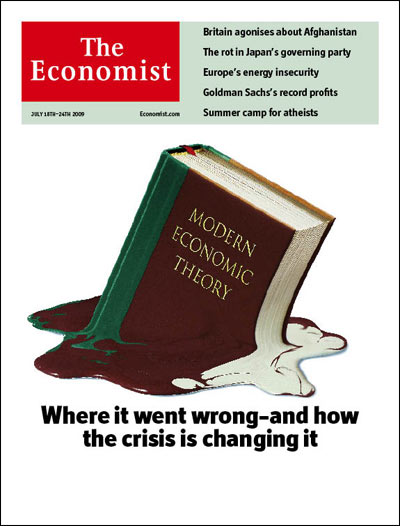
The Economist, 18 July 2009

economist 18 july 2009Three pieces in this issue address the state of economics as an academic discipline.  One laments the current state of macroeconomics, characterizing it as a discipline in which too many practitioners have been “seduced by their [theoretical] models” and have lost interest in data that might contradict those models.  Another discusses the efficient markets hypothesis, the role that hypothesis has played in shaping the theory and practice of modern finance, and tries to asses the likelihood that the efficient markets hypothesis will retain credibility in light of the world’s current financial crises.  A leading article calls on economists to bring about a “reinvention” of their discipline.  Evidently the requirements of this reinvention dictate that “Economists need to reach out from their specialised silos: macroeconomists must understand finance, and finance professors need to think harder about the context within which markets work. And everybody needs to work harder on understanding asset bubbles and what happens when they burst.”  Economists must recognize that “in the end” they are “social scientists, trying to understand the real world.”  I’ve always been rather skeptical of economics, but I suspect that most economists knew that last part already. 

There are also two pieces about lunar exploration.  One asks whether it makes sense to send more people to the Moon, quoting Buzz Aldrin’s opinion that it would be wiser simply to move on to other destinations.  Another reviews two new books on the Apollo 11 landing, in time for the 40th anniversary of that event.

The Nation, 3 August 2009

nation 3 august 2009Jonathan Schell’s remembrance of former Defense Secretary Robert Strange McNamara begins with the story of Schell’s meeting with McNamara in 1967, at which he, then a young reporter for The New Yorker, briefed the secretary on what he had seen American forces doing in Vietnam.  Schell would not hear from McNamara after that meeting, but declassified documents would subsequently reveal that the secretary had responded to it by attempting to discredit Schell’s story and block its publication.  Schell mentions McNamara’s subsequent contrition for his Vietnam policies, stressing that the remorse he suffered was quite trivial compared with the what the people of Vietnam suffered during the war McNamara did so much to design.  Still, Schell points out, McNamara was unique among high-level US policymakers of recent decades in publicly admitting error.  The piece ends with Schell’s line “If there is a statue made of McNamara, as there probably will not be, let it show him weeping.  It was the best of him.” 

(more…)

The USA and Pakistan’s nuclear arsenal

Dr Abdul Qadeer Khan

Dr Abdul Qadeer Khan

The 16-30 June issue of Counterpunch carries a brief article by Andrew Cockburn about US government backing for Pakistan’s nuclear weapons program.  In view of the concerns top American officials have expressed about the possibility that Pakistani nukes might fall into the hands of Bin Ladenite extremists, and of the fact that Dr. A. Q. Khan sold Pakistani nuclear material on an international black market, it is sobering to learn of the extent to which Washington has been involved in the development of Pakistan’s arsenal.  When CIA analyst Richard Barlow tried to blow the whistle on the US government’s complicity in helping Pakistan acquire nuclear weapons in the 1980s, his career was ruined.  Even the Khan affair doesn’t seem to have changed the CIA’s attitude; indeed, Khan’s shipping manager was a CIA agent.  The article lists an impressive array of malefactors involved in the business of promoting Pakistan’s nuclear ambitions.  Some of them, such as an unnamed group of “Israeli arms merchants,” are accustomed to bad press; others, such as the Dalai Lama, usually get friendlier publicity.