Yesterday, I tried to join a controversy on Language Log. The controversy was a lively one and comments I’ve posted there in the past have usually drawn some kind of response. So I was surprised that my offering was completely ignored. Today, I tried again.
All posts in category Language
I make another attempt to engage in controversy
Posted by acilius on September 30, 2009
https://losthunderlads.com/2009/09/30/i-make-another-attempt-to-engage-in-controversy/
I try, but fail, to enter a controversy
The other day, I posted a comment at Language Log which I was certain would draw some response. It did not.
The chief author of Language Log, University of Pennsylvania linguist Mark Liberman, had put up three posts (first, second, third) about the question of whether management types use “At the end of the day” as jargon. Professor Liberman searched various databases, found non-managers using the phrase, and declared the question settled. Various commenters were unconvinced. It seemed to me that several of them were trying to say that Professor Liberman was missing the point of the question. I agreed with them, and wrote this comment:
Posted by acilius on September 29, 2009
https://losthunderlads.com/2009/09/29/i-try-but-fail-to-enter-a-controversy/
Quotation “marks”
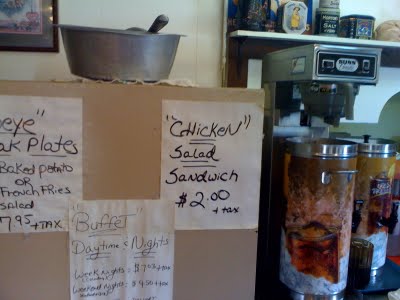
Via Language Log, a website devoted to pictures of signs that use quotation marks unnecessarily. It’s hilarious, as these examples should illustrate:
Well, it tastes like chicken…
To use the colloquialism, “and.”
He told me that was his name!
You wanna refund? I give you a real good refund, sure- right in da face!
Posted by acilius on September 23, 2009
https://losthunderlads.com/2009/09/23/quotation-marks/
Aptronyms
A new book about seahorses has appeared; the author is a marine biologist named Helen Scales. In its review, The Economist grants that “Scales” is an apt name for a person interested in fish.
Some new discoveries have come from examinations of old collections of butterflies; the lead researcher is a biologist named Emily Hornett. In his note about these findings, Ed Yong of Not Exactly Rocket Science mentions that Hornett is a “great name for an entomologist.”
A name that is especially suited to the profession of its owner is sometimes called an “aptronym.” The Wikipedia page for aptronyms lists some famous cases of this coincidence, including such ironic examples as the sometime primate of the Philippines, Jaime, Cardinal Sin. According to blogger and aptronym maven Nancy Friedman of the “Fritinancy” blog, the American Name Society had a panel about aptronyms at its annual session this January. Friedman cites a New York Times blog that had a little contest a couple of years ago for best aptronym; the winners included Peru, Indiana’s Eikenberry funeral home. Friedman also mentions that Slate has posted lists of aptronyms from time, including lawyer Soo Yoo, psychiatrist William Dement, and former White House press secretaries Larry Speakes, who spoke, and Tony Snow, who snowed ’em under. Here is a list of 180 aptronyms, including such worthies as a financial-services scammer named Robin Banks. Some aptronyms are really quite eloquent, as for example in the anti-Apartheid activism of actress Honor Blackman.
Posted by acilius on September 20, 2009
https://losthunderlads.com/2009/09/20/aptronyms/
Stating the obvious
Via LemmusLemmus, a true (or at least, extremely plausible) story of life in the academy:
A colleague presented a fairly complex paper on how firms might use warranties to extract rent from certain users of their products. No one in the audience seemed to follow the argument. Because I found the argument to be perfectly clear, I repeatedly defended the author and I was able to bring the audience to an understanding of the paper. The author was so pleased that I was able to understand his work and explain it to others that he asked me if I was willing to coauthor the paper with him. I said I would be delighted.
I immersed myself in the literature for a few months so that I could more precisely fit our contribution into the existing literature. We managed to reduce the equations in the paper to six. At this stage the paper was perfectly clear and was written at a level so that it could reach a broad audience. When we submitted the paper to risk, uncertainty, and insurance journals, the referees responded that the results were self-evident. After some degree of frustration, my coauthor suggested that the problem with the paper might be that we had made the argument too easy to follow, and thus referees and editors were not sufficiently impressed. He said that he could make the paper more impressive by generalizing the model. While making the same point as the original paper, the new paper would be more mathematically elegant, and it would become absolutely impenetrable to most readers. The resulting paper had fifteen equations, two propositions and proofs, dozens of additional mathematical expressions, and a mathematical appendix containing nineteen equations and even more mathematical expressions. I personally could no longer understand the paper and I could not possibly present the paper alone.
The paper was published in the first journal to which we submitted. It took two years to receive one referee report. The journal sent it out to a total of seven referees, but only one was able to write a report on it. Apparently he was sufficiently impressed. While the audience for the original version of the paper was broad, the audience for the published version of the paper has been reduced to a very narrow set of specialists and mathematicians. Even for mathematicians, the paper may no longer pass a cost-benefit test. That is, the time and effort necessary to read the paper may exceed the benefits received from reading it. I am now part of the conspiracy to intentionally make simple ideas obscure and complex.
The original paper, by David R. Hakes, can be downloaded as a pdf here.
Posted by acilius on September 18, 2009
https://losthunderlads.com/2009/09/18/stating-the-obvious/
An extreme case of the etymological fallacy
Yesterday on Language Log, Mark Liberman posted about the a curious claim that in the language of the Pashtun people of Afghanistan, “the word for ‘cousin’ is the same as the word for ‘enemy.’” Professor Liberman cannot find evidence to bear this claim out, and strongly suspects that it is bogus. What sticks in my mind is this quote Liberman gives from an essay by Louis Dupree collected in Islam and Tribal Societies, edited by Akbar Ahmed and David Hart (Routledge, 1984):
Language sometimes reveals unarticulated (or downplayed) conflicts in a society. The term for cousin in Pashto is turbur [and] the word for the worst kind of hatred is turburghanay which could be literally translated ‘cousin-hatred’. But the non-literate, rural Pushtun deny this interpretation. They say: ‘Turbur is turbur and turburghanay is turburghanay. They are separate words. How can they relate? How could I hate my cousin? I would fight to the death with him. I would never leave his body behind in a fight. I would give him my last crust of bread.’
The overwhelming majority of Afghans and Pakistanis cannot read and write, so showing them that the written turbur is a prefix and -ghanay a suffix, which, when combined create a compound word, fails to impress.
It’s hardly surprising that this fails to impress! Even assuming that Dupree’s etymology is correct, and that the turbur he hears in turburghanay is the word for cousin, we would hardly be warranted to assume that the currency of the word turburghanay implies that Pashtuns secretly hate their cousins. As Josh Fruhlinger puts it in a comment on Liberman’s post,
Particularly instructive and hilarious is the quote from the Ahmed and Hart piece, in which the learned outsiders pity the illiterate Pashtuns for not understanding the underlying etymological-psychological implications of the language that they (the Pashtuns) speak. People are determined to believe that language shapes thought even when the acutal speakers of said language don’t recognize the things embedded in the language that are supposed to be shaping their thoughts.
Posted by acilius on July 17, 2009
https://losthunderlads.com/2009/07/17/an-extreme-case-of-the-etymological-fallacy/
An abuse of power?

He's still getting people worked up
Andreas Willi, professor of Greek at Oxford, takes issue with a letter addressed to the US president that has lately been gathering signatures from American classical scholars. Willi’s article can be seen in pdf form here.
WHOSE IS MACEDONIA, WHOSE IS ALEXANDER?
On 18 May 2009, 200 Classical scholars from around the world sent an open letter to the President of the United States of America, Barack Obama. This unusual action, and the contents of the letter, raise issues which may not have been considered by all those who have endorsed it, but which deserve consideration. In order to put the discussion that follows into context, it may be useful first to quote the body of the letter itself. [[1]]
***
Dear President Obama,
We, the undersigned scholars of Graeco-Roman antiquity, respectfully request that you intervene to clean up some of the historical debris left in southeast Europe by the previous U.S. administration.
Posted by acilius on July 15, 2009
https://losthunderlads.com/2009/07/15/an-abuse-of-power/
Ukulele and Languages
Ukulele and Languages collects ukulele videos in (you’ll never guess!) various languages.
The latest post includes a couple of videos of Danish songs; this one, by “EvertParkLars,” is particularly likable.
Voodoo Marmalade is apparently Portugal‘s answer to the Ukulele Orchestra of Great Britain. They are off to a good start; considering that UOGB has been at it for 24 years, I hope no one will think I’m being sniffy if I say that Voodoo Marmalade has some way to go before they match them.
This page of eastern European ukuleleists ends with a video in Polish called “Ukulele Kajaki” (“Ukulele Kayak.”) I don’t understand a word of the lyrics, but the guy’s voice sounds like it’s saying something hilarious.
Is there Latin? Of course there’s Latin! Here’s “Love Machine” redone as “Machina Amoris.”
Posted by acilius on July 1, 2009
https://losthunderlads.com/2009/07/01/ukulele-and-languages/
Fast-talking furriners
From Ed Yong’s “Not Exactly Rocket Science,” a report on a recent study of turn-taking conventions among speakers of various languages. The surprising thing is how little variation there seems to be from culture to culture. It seems that every language group prizes speed of communication; nowhere is it the norm to pause noticeably between speakers. While I’m posting about Ed Yong’s coverage of linguistics, I should note that a few days ago he posted this piece about a study that seems to show that five-month old babies can recognize their native languages when they hear unfamiliar speakers use them.
Posted by acilius on June 19, 2009
https://losthunderlads.com/2009/06/19/fast-talking-furriners/
Goodnight Moon, Good Morning Phonetics
Here we have the children’s book Goodnight Moon set to music.
And here we have it in the International Phonetic Alphabet.
Posted by acilius on April 21, 2009
https://losthunderlads.com/2009/04/21/goodnight-moon-good-morning-phonetics/