The Nation, 9 November 2009

nation 9 nov 09For me, the highlight of this issue was a review of Mary Beard‘s The Fires of Vesuvius: Pompeii Lost and Found.  Beard’s “down to earth portrait of Pompeii” is informed by her grasp of “the latest research in demography, the history of Roman politics, architecture, ancient economics, feminist and post-colonial studies.” 

The same issue includes a number of articles about the war in Afghanistan.  As the editors summarize this symposium:

The principal rationale for America’s expanding military commitment in Afghanistan is that a Taliban takeover there would directly threaten US security because it would again become a safe haven for Al Qaeda to plot attacks against the United States. But the essays by Stephen Walt and John Mueller strongly refute that assumption, pointing out that a Taliban victory would not necessarily mean a return of Al Qaeda to Afghanistan, and that in any case the strategic value of Afghanistan and Pakistan as base camps for Al Qaeda is greatly exaggerated and can be easily countered.

Similarly, proponents of sending more troops to Afghanistan argue that Taliban success would embolden global jihadists everywhere and destabilize Pakistan in particular. Yet, as the essays by Selig Harrison and Priya Satia show, this narrative does not fit the realities. While American policy-makers and Al Qaeda may think of this as a grand meta-struggle between the United States and global jihadism, many Taliban fighters are motivated by other factors: by traditional Pashtun resistance to foreign occupation; by internal ethnic politics, such as rebellion against the Tajik-dominated government of Hamid Karzai; or by anger over the loss of life resulting from American/NATO aerial attacks that have gone awry.

As for Pakistan, the essays by Manan Ahmed and Mosharraf Zaidi explain why the Taliban threat to Pakistan is not as serious as many assume, and why a newly democratic Pakistan has turned increasingly against Islamist extremists. As Ahmed and Zaidi suggest, Pakistanis are quite capable of defending their country–not for American interests but for their own reasons–and Pakistani stability is more likely to be threatened than enhanced by military escalation in Afghanistan.

And finally, Robert Dreyfuss offers an exit strategy: as it winds down its counterinsurgency, Washington should encourage an international Bonn II conference that would lead to a new national compact in Afghanistan.

Well, not quite “finally.”  The issue also includes a piece by Ann Jones about Afghan women.  Jones mentions groups like Feminist Majority that argue for a continued US troop presence in the name of Afghan women’s rights.  She mentions her own years of experience working with women in Afghanistan, and gives it as her assessment that “an unsentimental look at the record reveals that for all the fine talk of women’s rights since the US invasion, equal rights for Afghan women have been illusory all along, a polite feel-good fiction that helped to sell the American enterprise at home and cloak in respectability the misbegotten government we installed in Kabul.”  In light of the fiercely patriarchal Shi’ite Personal Status Law (the SPSL, “or as it became known in the Western press, the Marital Rape Law,”) she goes on to say that “From the point of view of women today, America’s friends and America’s enemies in Afghanistan are the same kind of guys.”  She is unimpressed by the number of women in the Afghan parliament:

But what about all the women parliamentarians so often cited as evidence of the progress of Afghan women? With 17 percent of the upper house and 27 percent of the lower–eighty-five women in all–you’d think they could have blocked the SPSL. But that didn’t happen, for many reasons. Many women parliamentarians are mere extensions of the warlords who financed their campaigns and tell them how to vote: always in opposition to women’s rights. Most non-Shiite women took little interest in the bill, believing that it applied only to the Shiite minority. Although Hazara women have long been the freest in the country and the most active in public life, some of them argued that it is better to have a bad law than none at all because, as one Hazara MP told me, “without a written law, men can do whatever they want.”

Jones sees little hope, and much tragic irony in the possibilities facing Afghanistan:

So there’s no point talking about how women and girls might be affected by the strategic military options remaining on Obama’s plate. None of them bode well for women. To send more troops is to send more violence. To withdraw is to invite the Taliban. To stay the same is not possible, now that Karzai has stolen the election in plain sight and made a mockery of American pretensions to an interest in anything but our own skin and our own pocketbook. But while men plan the onslaught of more men, it’s worth remembering what “normal life” once looked like in Afghanistan, well before the soldiers came. In the 1960s and ’70s, before the Soviet invasion–when half the country’s doctors, more than half the civil servants and three-quarters of the teachers were women–a peaceful Afghanistan advanced slowly into the modern world through the efforts of all its people. What changed all that was not only the violence of war but the accession to power of the most backward men in the country: first the Taliban, now the mullahs and mujahedeen of the fraudulent, corrupt, Western-designed government that stands in opposition to “normal life” as it is lived in the developed world and was once lived in their own country. What happens to women is not merely a “women’s issue”; it is the central issue of stability, development and durable peace. No nation can advance without women, and no enterprise that takes women off the table can come to much good.

Jones knows Afghanistan quite well; I know it not at all.  I can only hope that there is something left in the local culture of the seeds from which a relatively woman-friendly Afghanistan once grew, and that those seeds will again send up green shoots once foreign armies leave the country .

How many people lived in Rome in the first century BC?

Sulla: He kept the Romans' numbers down

Sulla: Mr Zero Population Growth

During the first century BC, Rome experienced a series of civil wars.  Dynasts like Marius, Sulla, Caesar, Antony, and Octavian led armies that slaughtered foreigners and Romans alike.  Romans responded to these wars by hoarding their wealth.  They hoarded some of this wealth by burying coins.  Not all of the first-century Romans who buried coins had a chance to dig their coins up again.  Some of the coins they buried have come to light only in recent centuries.  Scholars study these newly recovered coins to learn about life in ancient times. 

Historian Walter Scheidel and biologist Peter Turchin have looked at some of these recently uncovered first-century BC hoards of coins in Rome.  Using analytic techniques developed by biologists, Scheidel and Turchin have concluded that the population of Rome in those days was considerably smaller than has often been estimated.  The civil wars evidently took so heavy a toll on the Romans that the city’s population by the end of the first century was not likely more than half of the number some previous historians have estimated.

What you see depends on what you look for

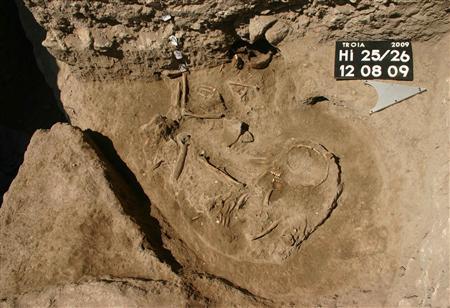
the findHere are two reports on the same archaeological find.  From Reuters:

ANKARA (Reuters) – Archaeologists in the ancient city of Troy in Turkey have found the remains of a man and a woman believed to have died in 1,200 B.C., the time of the legendary war chronicled by Homer, a leading German professor said on Tuesday.

Ernst Pernicka, a University of Tubingen professor of archaeometry who is leading excavations on the site in northwestern Turkey, said the bodies were found near a defense line within the city built in the late Bronze age.

The discovery could add to evidence that Troy’s lower area was bigger in the late Bronze Age than previously thought, changing scholars’ perceptions about the city of the “Iliad.”

“If the remains are confirmed to be from 1,200 B.C. it would coincide with the Trojan war period. These people were buried near a moat. We are conducting radiocarbon testing, but the finding is electrifying,” Pernicka told Reuters in a telephone interview.

Ancient Troy, located in the northwest of modern-day Turkey at the mouth of the Dardanelles not far south of Istanbul, was unearthed in the 1870s by Heinrich Schliemann, the German entrepreneur and pioneering archaeologist who discovered the steep and windy city described by Homer.

Pernicka said pottery found near the bodies, which had their lower parts missing, was confirmed to be from 1,200 BC, but added the couple could have been buried 400 years later in a burial site in what archaeologists call Troy VI or Troy VII, different layers of ruins at Troy.

Tens of thousands of visitors flock every year to the ruins of Troy, where a huge replica of the famous wooden horse stands along with an array of excavated ruins.

(Writing by Ibon Villelabeitia; Editing by Ralph Boulton)

From Digital Journal, under the headline “Remains of Ancient Trojan Warriors Found”:

Archaeologists in Turkey have found the remains of a man and a woman who died fighting in the legendary Siege of Troy, some 3,000 years ago.
According toReuters, the bones of the two were discovered in the layers VI and VII. Troy VII is believed to be the site of the legendary war brought about by the abduction of the beautiful Helen, Queen of Sparta, by Paris, prince of Troy. The siege of Troy by Greek heroes is the subject of theIlliadby the great poet of antiquity, Homer. Ernst Pernicka, an archaeologist from the University of Tübingen, said:

We were able to calculate their approximate times of death and their ages. If our estimates are correct, we can confirm that we have found the first dead of the Trojan War.

The report said archaeologists could also increase their estimates of the size of the ancient city, as the recent excavations show a larger Bronze Age settlement than was previously believed. Pernicka told Reuters:

If the remains are confirmed to be from 1,200 B.C. it would coincide with the Trojan war period. These people were buried near a moat. We are conducting radiocarbon testing, but the finding is electrifying,

The German amateur archaeologist Heinrich Schliemann discovered the remains of the city in 1871. The ruins of Troy near the Dardanelles Straight remain one of Turkey’s key tourist attractions.

Digital Journal illustrates its piece, not with the photo of the find above, but with an image of a warrior’s helmet.

Weighty matters

An artist's conception of the field pack ancient Roman soldiers wore

An artist's conception of the field pack ancient Roman soldiers wore

About seven years ago, I read G. R. Watson’s The Roman Soldier (originally published by Cornell University in 1969; I read a copy of the 1985 paperback reissue), a handbook summarizing what scholars in 1969 knew about life in the ancient Roman army.  One point Watson made that I’ve been thinking about ever since I read the book had to do with the field packs Roman soldiers wore.  Some scholars in Germany had tended to give very high estimates of the amount of weight that Roman soldiers had to carry, in some cases solemnly asserting that a legionary would march about all day with over a hundred pounds of equipment on his back.  Dismissing these estimates as a self-evident absurdity, Watson tries to figure out just how heavy the pack might have been (in the 1985 reissue, that discussion is on pages 62-66, continued in note 140 on pages 175-176.)  The best estimate he can come up with puts the average weight of the Roman soldier’s pack at 30 kilograms (66 pounds,)which happens to be identical to the standard for most modern armies. 

Watson’s evidence suggests that throughout history armies have tended to increase the amount of weight soldiers have to carry, until the kit becomes so heavy that the high command has no choice but to cut it down to something weighing about 30 kilograms.  I suppose that the obvious reason for this tendency is that many people are involved in deciding what it is essential that a soldier should carry in the field.  Each of those people has ideas about items that should be on that list, and each sees the addition of his or her favorite item as a victory.  When no one involved in decision-making at that level has to wear a full field pack on a regular basis, the decision makers have no immediate incentive to deny each other their little victories.     

I wonder if there might not be a second, less obvious reason for this tendency.  Ed Yong’s Not Exactly Rocket Science reports on a psychological experiment which indicates that people who are holding heavy objects tend to take matters more seriously than the same people do when they are not holding heavy objects.  If this tendency is and has long been general among all humans everywhere, then we would expect that people who are interested in human behavior would have noticed it.  Military commanders are interested in human behavior.  Perhaps, noticing the overlap between the category “people holding heavy objects” and the category “people showing seriousness,” commanders have formed the idea that they could induce ever greater seriousness in their subordinates by weighing them down with ever more heavily loaded field packs. 

If there’s anything to this speculation of mine, perhaps it is also part of the reason why there is so little protest against the spine-damagingly heavy backpacks that so many American children are forced to lug to and from school every day.  Of course, many people are involved in deciding what a student should learn and do in school, and that is an obvious reason why the collection of textbooks and other materials students must transport on their persons tend to grow so heavy. 

heavy backpackBut perhaps a belief that the weight of the physical burden one carries correlates directly with the seriousness of one’s attitude is also part of it.  We want children to take school seriously.  We have observed that people holding heavy objects tend to be serious.  If holding heavy objects translates into seriousness, maybe holding even heavier objects will translate into even more seriousness!  It will definitely translate into more back injuries, but isn’t that a small price to pay for keeping the wee ones doubled over for much of the day?

The American Conservative, September 2009

american conservative september 2009One of the traits of this magazine is a tendency to grandiose theoretical explanations.  That’s one of the things I like about it; I’m into grandiose theoretial explanations myself.  It isn’t scholarly publication, and few of its authors have academic reputations to defend, so that tendency is not always restrained by the standards that keep theorizing under control in academic journals.  Sometimes that means that the magazine runs a provocative, bold idea that might not have survived heavier editing; sometimes it means that it runs something that’s just plain cheesy quality.  Again, I’m a pretty cheesy guy, so that’s okay with me. 

For example, this month Ted Galen Carpenter points out that Americans by and large are quick to view political disputes in foreign countries in a romantic light, seeing the ghost of Thomas Jefferson in all sorts of unlikely figures.  The next piece, by John Laughland, picks up on this same theme, explaining this American tendency as a sign of the influence of the philosophy of the Enlightenment.  Laughland writes that “the key to understanding the West’s love of revolutions” is Westerners’ characteristic desire to believe that “politics can and should be a story with a happy ending.”  This desire has run rampant in the West ever since the thinkers of the Enlightenment undermined the traditional Christian belief that the cosmos was ordered in a hierarchy, that justice was to be found in that hierarchy, and that the ruler’s power should be limited because the ruler was subordinate to God.  Laughland identifies Immanuel Kant as “the greatest of all Enlightenment philosophers,” and summarizes Kant’s theory as a belief that ordinary reality is unknowable, but that the highest reality is “the categorical imperative- an abstract universally valid proposition that becomes real when it is willed.”  Proceeding from these rather drastic simplifications, Laughland declares that:

The attraction of Enlightenment liberalism, therefore, is the result of a deep emotional need for a philosophical sytem that enables man to create a reality in a universe he does not understand and thereby to escape from the difficulties of the world by believing that everything will turn out all right in the end.  Lacking a real belief in the afterlife, it also holds that the drama of human salvation is played out in this world, in history and politics. 

Again, this is a severe oversimplification, but it has a certain plausibility.  Where Laughland really goes off the rails is in his closing section, in which he argues that Enlightenment liberalism has an “objective ally” in Islam:

[B]ecause it has no priesthood, Islam, and especially Shi’ism, is fundamentally a “democratic” religion comparable to Puritanism and other forms of Presbyterianism.  There is no established hierarchy; the Koran must be read equally by all.  Of course Allah is supreme and Islam demands absolute submission to Him; on the face of it, this seems the opposite of the liberal model in which the individual is subjected only to himself.  But this very submission is egalitarian, creating a mass of individuals who are equal in their abstractness.  Moreover, God’s will is [merely] will, it has no correlation with natural law as in the Christian or Jewish traditions.  Islam is therefore a profoundly voluntarist religion.  Because Allah is absolutely transcendent and unknowable, he is like the Kantian thing-in-itself: mere command. 

(more…)

An abuse of power?

He's still getting people worked up

He's still getting people worked up

Andreas Willi, professor of Greek at Oxford, takes issue with a letter addressed to the US president that has lately been gathering signatures from American classical scholars.  Willi’s article can be seen in pdf form here.

WHOSE IS MACEDONIA, WHOSE IS ALEXANDER?

On 18 May 2009, 200 Classical scholars from around the world sent an open letter to the President of the United States of America, Barack Obama. This unusual action, and the contents of the letter, raise issues which may not have been considered by all those who have endorsed it, but which deserve consideration. In order to put the discussion that follows into context, it may be useful first to quote the body of the letter itself. [[1]]

***

Dear President Obama,

We, the undersigned scholars of Graeco-Roman antiquity, respectfully request that you intervene to clean up some of the historical debris left in southeast Europe by the previous U.S. administration.

(more…)

Why are there 60 minutes in an hour?

Thanks to 3quarksdaily for posting about this article that answers the question “How did the Sumerians count to 12 on one hand and to 60 on two?”

Down with Justinian!

justinian-mosaic

In ancient times, the Romans observed a festival called the Parilia every year on 21 April.  We remember this festival as “Foundation of Rome Day,” since first-century Romans like Ovid believed that 21 April was the day when Romulus laid out the boundaries of the new city.  The Romans settled on  753 BC as the year of the city’s founding only centuries after they had agreed on 21 April as the day.  From their point of view, the day returned regularly and could be celebrated, while the year was gone forever and therefore had no practical value.   

Apparently to emphasize the association between the Parilia and the founding of Rome, the emperor Hadrian changed the name of the festival to Romaea in AD 121.  The importance of 21 April outside the city of Rome rather declined as the center of the empire moved eastward in the centuries after Hadrian; by the time the western empire officially collapsed in AD 476, it is doubtful whether the festival was observed in the east at all.  When in AD 547 the Byzantine emperor Justinian decreed a new system for naming years, the Romaea or Parilia lost all official status in the east. 

So, those of us who have a soft spot for Foundation of Rome Day have a grudge against Justinian.  Apparently, we are represented at Language Log, where Bill Poser today posts a note about some of the more hideous aspects of Justinian’s proudest achievement, the law code known as the Corpus Iuris Civilis.

The Nation, 27 April 2009

nation-27-april-2009Classicist Emily Wilson reviews Anne Carson‘s An Oresteia.  Carson translates Aeschylus’ Agamemnon, Sophocles’ Electra, and Euripides’ Orestes to make a trilogy that not only tells why the legendary prince Orestes killed his mother Clytemnestra and what consequences that matricide had in their world, but a trilogy that also suggests how the moral ideas of the Athenians might have changed in response to the social and political crises of the fifth century BC.  

Aeschylus’ Agamemnon was produced in 458 BC, when Athens’ empire was at its zenith and its form of democracy seemed infinitely adaptable to whatever challenges the future might present.  In the Agamemnon, Aeschylus puts the motivations of the gods and of humans on display together, suggesting that while each may be temporarily obscure, nonetheless both can ultimately become transparent.   When Clytemnestra kills her husband Agamemnon, her children inherit from their father the responsibility to avenge him by killing their mother.  Faced with this horrifying duty, Orestes and his sister Electra seem as though they may have been plunged into an incomprehensible moral universe.  Yet democracy, Athenian democracy, will settle the matter and allow the survivors of the cycle of violence to reason together once more.   Orestes will ultimately appear before Athens’ Areopagus Council, which will sit in judgment of his case and reach a verdict that even the Furies themselves must accept. 

Sophocles’ Electra dates from a time much later than that of Aeschylus’ play, probably the last decade of the fifth century.  By that time, Athens had been embroiled in the Peloponnesian Wars for a generation.  Isolated in mainland Greece, Athens had suffered heavy defeats in one theater after another.  To many Athenians, it seemed that the war had discredited democracy.  Not only had the war the people voted to enter brought Athens actual disaster and likely destruction, but the heaviest of all Athens’ losses were suffered in a war with another radical democracy, Syracuse.  In 411, Sophocles himself would figure prominently in a move to scrap democracy and institute a government by an oligarchic group known as “the Four Hundred.”  The Four Hundred didn’t last long, but the optimism of Aeschylus’ day would never be possible to the Athenians again.  Accordingly, Sophocles’ view is darker Aeschylus’.  Wilson says that for Sophocles, “the will of the gods is hard to interpret, and the focus of the play is on the turbulent feelings of human characters and the contradictory narratives they create to serve their advantage.”  For my part, I think it would be better to say that for Sophocles, the gods are not on display- we may be visible to them, but they are never truly visible to us.  We can understand only his human characters, and then only by discovering the ways in which they have deceived themselves.  Wilson writes that “The play is disturbing in both its emphasis on desperate grief and the suggestion that the only cure for such pain is retribution reaped with scams and lies. Unlike in Aeschylus, there is no hope of a political solution.” 

Orestes, produced in 408, is in some ways Euripides’ strangest play, and Wilson labels it the darkest of the three Carson has chosen.  Euripides is closer to Aeschylus than to Sophocles in his belief that the motivations of gods and humans are intelligible, but unlike them in his doubt that understanding those motivations will bring us any closer to a world that we can judge fairly.  (more…)

The Nation, 26 January 2009

26-jan-nationEric Foner finds much to praise in Abraham Lincoln, chiefly his “capacity for growth” and his belief that “there was a bedrock principle of equality that transcended race- theequal right to the fruits of one’s labor.”  Foner dwells on the Second Inaugural, asking us to imagine the moral courage it must have required for Lincoln to name the evil at the heart of the Civil War not as Southern treason, but as “American slavery.”  The famous passage saying that we must acquiesce in God’s will to punish us for that sin even if  “all the wealth piled by the bondman’s two hundred and fifty years of unrequited toil shall be sunk, and until every drop of blood drawn with the lash shall be paid by another drawn by the sword” raises Foner’s special approbation.  “In essence, Lincoln was asking Americans to confront unblinkingly the legacy of bondage and to think about the requirements of justice.”

Two other pieces deal with the relationship between modern institutions and the ancient past.  Britt Peterson‘s  review of several books about looted work from southwest Asia and southeast Europe that has made its way into museums around the world begins with a story that raises a basic question.  In 1995, the Metropolitan Museum of Art in New York was forced to send acollection known as”the Lydian hoard” to Turkey, since the artifacts had been stolen from sites in that country.  However, the Turks had not yet come to Turkey when those artifacts were produced in the seventh and sixth centuries BC.  Therefore, the artifacts are not especially interesting to nationalist-minded Turks.  They are now housed in a small museum in the town of Usak.  This museum receives barely 100 visitors a year, fewer than the exhibit used to recieve in a typical  hour at the Met.  Some pieces have been stolen and replaced with obvious copies.  Do the artifacts have a value intrinsic to themselves?  Or is their worth a function of the use we make of them and the concern we have for them?  If the latter is the case, then what, exactly, was stolen from the Turks when the Hoard was originally looted? 

Anthony Grafton’s review of the recently published correspondence of Gershon Scholem and Morton Smith revolves around the question of whether Morton Smith’s greatest claim to fame was a forgery.  In 1973, Morton Smith published a document that he claimed to have discovered fifteen years before.  This Greek manuscript, apparently written in the eighteenth century, Morton Smith identified as a copy of a second century letter from one of the fathers of the church, Clement of Alexandria.  The letter consisted of a complaint that a group of heretics were giving Christianity a bad name by following practices outlined in a text they called “the secret gospel of Mark.”  The letter allows that there was in fact a secret gospel of Mark, which added to the canonical gospel stories about Jesus initiating select followers into mysterious kinds of knowledge.  The heretics, the letter claims, have taken this secret gospel and added even more to it.  In fact, they claimed that Christians were exempt from all moral laws and could find salvation by committing sins.  Their favorite sins seems to have involved homosexual behavior, and their version of “secret Mark” seems to have suggested that Jesus also had a fondness for such behavior. 

As soon as Morton Smith published the letter, there was suspicion that it was a forgery.   Red flags went up when it was noticed that every single word in the letter appears somewhere else in the extant works of Clement of Alexandria.  Students preparing assignments for ancient Greek and Latin prose composition classes have traditionally been required to imitate the style of one or another ancient author.  Those students will typically draw their vocabulary from lists of words their model used.  But of course the author himself would not have had such a list in front of him. Writing in his native language, he would have been at liberty to use whatever word seemed best to him.  Indeed, no ancient text of any substance consists exclusively of words the author uses elsewhere.  The fact that this letter does makes it look more like the work of an outstanding Greek prose comp student, which Morton Smith was, than like a genuine ancient text.  As a clincher, a writer named Stephen Carlson pointed out that a reference to the packaging of salt in “Clement’s” letter makes no sense in the context of ancient practices, but is intelligible only in light of the anti-clumping process patented in 1910 by the Morton Salt Company.  Thus, Morton Smith may have signed his work.

UPDATE:  It’s in this issue that Stuart Klawans praises Silent Light, Carlos Reygadas’ film about Mennonites in Mexico, and delivers one-paragraph slams against Oscar contenders The Curious Case of Benjamin Button, Slumdog Millionaire, The Reader, Revolutionary Road, and Doubt.   I’ve seen Doubt and liked it, but his description is as funny as it is unfair:

Doubt: It was a dark and stormy night in American Catholicism, when Sister Meryl Streep and Father Philip Seymour Hoffman settled in for 104 minutes of shouting at each other. Co-starring Amy Adams as the sweetest young nun in the parish–a role I’d be happy to see her play, if John Waters were the director. Maybe in the new year.