
Thanks to haha for linking to this LA Times story in which a woman tells what it was like to spend the first 48 years of her life unable to see in three dimensions, and what it was like to gain that ability in middle age.
All posts by acilius
She grew up without a View-Master
Posted by acilius on July 17, 2009
https://losthunderlads.com/2009/07/17/she-grew-up-without-a-view-master/
An extreme case of the etymological fallacy
 Yesterday on Language Log, Mark Liberman posted about the a curious claim that in the language of the Pashtun people of Afghanistan, “the word for ‘cousin’ is the same as the word for ‘enemy.’” Professor Liberman cannot find evidence to bear this claim out, and strongly suspects that it is bogus. What sticks in my mind is this quote Liberman gives from an essay by Louis Dupree collected in Islam and Tribal Societies, edited by Akbar Ahmed and David Hart (Routledge, 1984):
Language sometimes reveals unarticulated (or downplayed) conflicts in a society. The term for cousin in Pashto is turbur [and] the word for the worst kind of hatred is turburghanay which could be literally translated ‘cousin-hatred’. But the non-literate, rural Pushtun deny this interpretation. They say: ‘Turbur is turbur and turburghanay is turburghanay. They are separate words. How can they relate? How could I hate my cousin? I would fight to the death with him. I would never leave his body behind in a fight. I would give him my last crust of bread.’
The overwhelming majority of Afghans and Pakistanis cannot read and write, so showing them that the written turbur is a prefix and -ghanay a suffix, which, when combined create a compound word, fails to impress.
It’s hardly surprising that this fails to impress! Even assuming that Dupree’s etymology is correct, and that the turbur he hears in turburghanay is the word for cousin, we would hardly be warranted to assume that the currency of the word turburghanay implies that Pashtuns secretly hate their cousins. As Josh Fruhlinger puts it in a comment on Liberman’s post,
Particularly instructive and hilarious is the quote from the Ahmed and Hart piece, in which the learned outsiders pity the illiterate Pashtuns for not understanding the underlying etymological-psychological implications of the language that they (the Pashtuns) speak. People are determined to believe that language shapes thought even when the acutal speakers of said language don’t recognize the things embedded in the language that are supposed to be shaping their thoughts.
Posted by acilius on July 17, 2009
https://losthunderlads.com/2009/07/17/an-extreme-case-of-the-etymological-fallacy/
The Economist, 18 July 2009
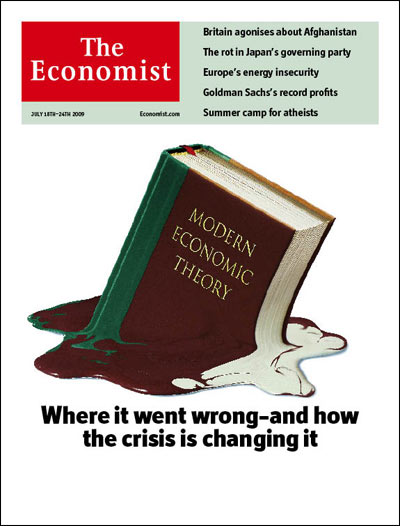 Three pieces in this issue address the state of economics as an academic discipline. One laments the current state of macroeconomics, characterizing it as a discipline in which too many practitioners have been “seduced by their [theoretical] models” and have lost interest in data that might contradict those models. Another discusses the efficient markets hypothesis, the role that hypothesis has played in shaping the theory and practice of modern finance, and tries to asses the likelihood that the efficient markets hypothesis will retain credibility in light of the world’s current financial crises. A leading article calls on economists to bring about a “reinvention” of their discipline. Evidently the requirements of this reinvention dictate that “Economists need to reach out from their specialised silos: macroeconomists must understand finance, and finance professors need to think harder about the context within which markets work. And everybody needs to work harder on understanding asset bubbles and what happens when they burst.” Economists must recognize that “in the end” they are “social scientists, trying to understand the real world.” I’ve always been rather skeptical of economics, but I suspect that most economists knew that last part already.
There are also two pieces about lunar exploration. One asks whether it makes sense to send more people to the Moon, quoting Buzz Aldrin’s opinion that it would be wiser simply to move on to other destinations. Another reviews two new books on the Apollo 11 landing, in time for the 40th anniversary of that event.
Posted by acilius on July 16, 2009
https://losthunderlads.com/2009/07/16/the-economist-18-july-2009/
The Nation, 3 August 2009
 Jonathan Schell’s remembrance of former Defense Secretary Robert Strange McNamara begins with the story of Schell’s meeting with McNamara in 1967, at which he, then a young reporter for The New Yorker, briefed the secretary on what he had seen American forces doing in Vietnam. Schell would not hear from McNamara after that meeting, but declassified documents would subsequently reveal that the secretary had responded to it by attempting to discredit Schell’s story and block its publication. Schell mentions McNamara’s subsequent contrition for his Vietnam policies, stressing that the remorse he suffered was quite trivial compared with the what the people of Vietnam suffered during the war McNamara did so much to design. Still, Schell points out, McNamara was unique among high-level US policymakers of recent decades in publicly admitting error. The piece ends with Schell’s line “If there is a statue made of McNamara, as there probably will not be, let it show him weeping. It was the best of him.”
Posted by acilius on July 16, 2009
https://losthunderlads.com/2009/07/16/the-nation-3-august-2009/
Knowledge is its own reward

In Consultation, by Joseph Schippers
Dostoevsky sometimes had his intellectual characters ask each other if they would rather be clever and miserable or stupid and happy. If they claimed they would rather be stupid and happy, he had them jeer at each other. “You’d have me believe that you could be like the simplest peasant woman, believe everything she believes, if it meant happiness?” Evidently he thought that clever people needed cleverness more than they needed happiness.
It seems that Dostoevsky would have been at home among rhesus monkeys. Ed Yong reports on an experiment in which rhesus monkeys were offered varying amounts of water and the opportunity to know how much water they were about to be offered. The monkeys showed an interest in knowing how much water they were about to be offered that had no connection with the water itself.
Posted by acilius on July 15, 2009
https://losthunderlads.com/2009/07/15/knowledge-is-its-own-reward/
An abuse of power?

He's still getting people worked up
Andreas Willi, professor of Greek at Oxford, takes issue with a letter addressed to the US president that has lately been gathering signatures from American classical scholars. Willi’s article can be seen in pdf form here.
WHOSE IS MACEDONIA, WHOSE IS ALEXANDER?
On 18 May 2009, 200 Classical scholars from around the world sent an open letter to the President of the United States of America, Barack Obama. This unusual action, and the contents of the letter, raise issues which may not have been considered by all those who have endorsed it, but which deserve consideration. In order to put the discussion that follows into context, it may be useful first to quote the body of the letter itself. [[1]]
***
Dear President Obama,
We, the undersigned scholars of Graeco-Roman antiquity, respectfully request that you intervene to clean up some of the historical debris left in southeast Europe by the previous U.S. administration.
Posted by acilius on July 15, 2009
https://losthunderlads.com/2009/07/15/an-abuse-of-power/
Red State Update
Thanks to “Kate L,” a frequent commenter on Alison Bechdel’s Dykes to Watch Out For, for pointing us to this video:
Posted by acilius on July 10, 2009
https://losthunderlads.com/2009/07/10/red-state-update/
Banana Furniture


Posted by acilius on July 10, 2009
https://losthunderlads.com/2009/07/10/banana-furniture/
The USA and Pakistan’s nuclear arsenal

Dr Abdul Qadeer Khan
The 16-30 June issue of Counterpunch carries a brief article by Andrew Cockburn about US government backing for Pakistan’s nuclear weapons program. In view of the concerns top American officials have expressed about the possibility that Pakistani nukes might fall into the hands of Bin Ladenite extremists, and of the fact that Dr. A. Q. Khan sold Pakistani nuclear material on an international black market, it is sobering to learn of the extent to which Washington has been involved in the development of Pakistan’s arsenal. When CIA analyst Richard Barlow tried to blow the whistle on the US government’s complicity in helping Pakistan acquire nuclear weapons in the 1980s, his career was ruined. Even the Khan affair doesn’t seem to have changed the CIA’s attitude; indeed, Khan’s shipping manager was a CIA agent. The article lists an impressive array of malefactors involved in the business of promoting Pakistan’s nuclear ambitions. Some of them, such as an unnamed group of “Israeli arms merchants,” are accustomed to bad press; others, such as the Dalai Lama, usually get friendlier publicity.
Posted by acilius on July 8, 2009
https://losthunderlads.com/2009/07/08/the-usa-and-pakistans-nuclear-arsenal/
Don’t we all know how she feels?
Thanks to haha.nu:

Posted by acilius on July 8, 2009
https://losthunderlads.com/2009/07/08/dont-we-all-know-how-she-feels/
Who writes this?
 acilius
 believer1
 lefalcon
 losthunderlads
 vthunderlad
 Panther Red